Our final destination was Cedar Grove where our tour guide was Kathy McCracken. Because of the generosity of Lydia Thompson Morris (1849-1932), we are able to enjoy the architectural beauty and interior furnishings of Cedar Grove.Her father, Isaac Paschall Morris (1803-1869), was the only male to inherit Cedar Grove. Due to his involvement in the iron industry, he was considered one of the twenty richest men in Philadelphia. Railroad construction dissected the property in 1888, and the home along with all of its furnishings had to be moved from the Frankford section of Philadelphia.
Through the encouragement of Fiske Kimball at the Philadelphia Museum of Art, the house and museum were donated to Fairmount Park. In their 50th Annual Report, the Pennsylvania Museum and School of Industrial Art wrote in May 31, 1926:
Through the generosity of Miss Lydia Thompson Morris, the house of the Morris family, Cedar Grove, Harrowgate, is being removed and re-erected near the Museum, with the understanding that is will be filled with its original furnishings of the period 1714-1791 and be similarly opened under the custodian-ship of the Museum.
The architectural firm of Ritter and Shay provided the blueprints for dismantling Cedar Grove. And so began the painstaking process of marking every stone and board and reassembling them as they fit like a jigsaw puzzle.. William Carver, the relocation supervisor, stated "only three beams had decayed to the extent of having been replaced." The Philadelphia Inquirer reported in February 1927, "Attention to detail had been remarkable in the rebuilding ... Every stone, every piece of wood (and they number into thousands) was marked carefully and was replaced exactly as it has been before demolition."
It took two years to complete the assembly. Cedar Grove was dedicated in 1928. The vision of Lydia Thompson Morris came to fruition. The colonial house built in 1748-1750 was saved from demolition.
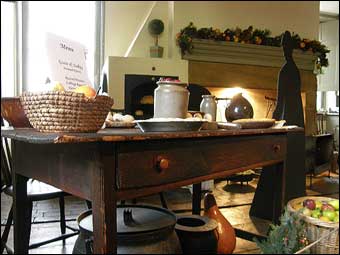
Cedar Grove kitchen
The original owner was a Quaker, Elizabeth Coates Paschall. Her father, Thomas Coates, willed Elizabeth his house on the north side of High Street in Philadelphia upon his death on July 22, 1719. He also gave to each of his children a golden Jacobus with the intentions of never to spend it unless they were in need of bread. The one piece know to exist was given to Elizabeth and handed down to the great grandson, John T. Morris.
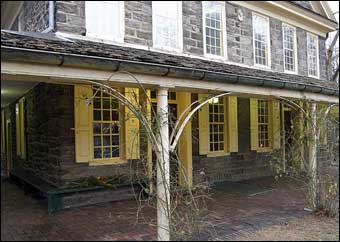
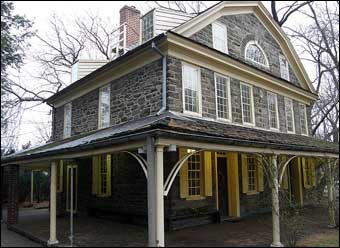
Her husband, Joseph, ran a successful dry goods business. However, in 1742 at the age of 41 he died. She had purchased fifteen acres next to her brother's farm know known as Harrowgate which was known for its mineral springs. She commissioned a small summer home to be built in 1748. The work was done mostly by a stonemason, Griffith Griffith, and a carpenter, John Hitchcock. They used a grey native stone. Ashlar masonry is used to dress the front side of the house while carefully fitted rubblework adorns the other faces of the exterior wall. The house consisted of two large rooms, a bedroom and parlor and a garret and lean-to kitchen. The house was enlarged two years later with an extension of the second story and a garret built over the one-story kitchen
Only three of Elizabeth's children survived which made her interested in medicinal herbs. On the grounds was a medicinal herb garden. She proudly recorded many medicinal recipes as"my own Invention." She discussed the best cures with doctors, relatives, friends, botanists, native Americans, and apothecaries. She compiled a book with 212 recipes.
Bathing Room, 1799 addition
Upon the death of Elizabeth in 1768, Cedar Grove passed to her unmarried daughter, Beulah (1732-1793), who raised her two nieces after the death of her brother, Isaac. Her one niece, Sarah inherited Cedar Grove in 1795, then married Isaac Wistar Morris December 17 of the same year. Isaac and his brother Luke controlled a brewery at Dock and Pear streets. The house was more than doubled in size in 1799 to 38 X 50 feet. The parlor and kitchen were enlarged, two bedrooms and a bathing room were added, and a third floor was built. The roof was raised into a gambrel pitch to created four more bedrooms. Cedar Grove was no longer considered a summer home. Sarah and Isaac had nine children. Isaac retired from the brewery in 1810. The piazza was added in 1848 when there were many formal and informal gatherings of local Quaker families.
Chippendale high chair and other original pieces on the second floor in the bedroom
Isaac and Sarah passed Cedar Grove down to their third son, Isaac Paschall Morris who was educated as a druggist. The firm of Ellis & Morris was a successful drug business at No. 56 Chestnut Street. However, Isaac no longer enjoyed the business, and started the the successful ironworks at Sixteenth and Market Streets in the 1840's.
The final inhabitants of Cedar Grove were Lydia Thompson Morris and her brother John
who took over in 1869. The expansion of industries in the area caused the living conditions to be unbearable. By 1888, the brother and sister found it necessary to build their next home in Chestnut Hill, Compton, which is now part of Morris Arboretum. All the furniture was moved from Cedar Grove to Compton. Eventually Compton was demolished in 1968, but Cedar Grove was saved for other generations to enjoy. It is maintained by the Philadelphia Museum of Art
Rocking windsor chair
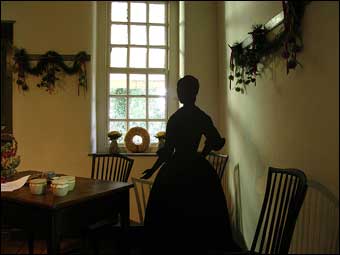
The theme for the Holiday House Tour was perfectly fitting of subject matter, "Scenes from a Woman's World." Kathy McCracken made a special trip to the second floor to show us how the generations of Coates, Paschall and Morris families lived. The house is truly a mixture of Baroque, Rococo, and Federal styles.
Be sure to add the Fairmount Park Holiday Tours to your holiday destinations next year.



 Sweetbriar Mansion