Mount Pleasant

Exterior of Lemon Hill Mansion

Mantle decorated for the Holiday Tour
There has been intense debate over the years whether or not Morris built a home on the land. Apparently he established a farm and erected some structures by 1774. There is no mention of any buildings on the deed. There was constant threat of the British occupying the land during the War. With the advance of General Howe in 1777, Morris did leave the area. The British evacuated Philadelphia July 13, 1778. Josiah Bartlett wrote to Colonel Langdon on the same day, "the country Northward of the City for several miles in one common waste... Mr. Dickinson and Morris's fine seats all Demolished."
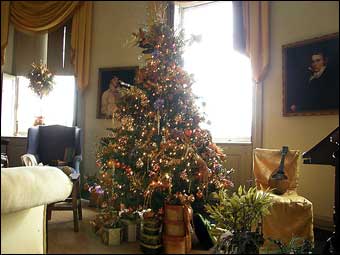
A decorated tree for the Holiday Tour
Sunday, 10. Breakfasted by agreement at Mr. Powels, and in company with him, rode to see the Botanical Gardens of Mr. Bartram, which, though stored with may curious Trees, shrubs and flowers, was neither large, nor laid out in much taste ... From hence, visited Mr. Powel's farm, after which I went to Mr. Morris' country seat to dinner by appointment, and returned to the city about dark.
Wednesday, 22. Dined at the Hill, Mr. Morris's, and visited at Mr. Powels in the evening.
Sunday, 26. Rode into the country 8 or 10 miles and dined with Mr. Morris at the Hills and spent the evening writing letters.
Sunday, 16. Wrote many letters in the forenoon, dined with Mr. and Mrs. Morris at the HIlls and returned to town in the evening.

A table setting for dinner in the 18th century
The greenhouse on the property was one of the finest in American. It is described in 1797:
... a large and elegant green-house, with a hot house of fifty foot front of each side, on the back front of a House for a gardner, with a kitchen, one large and five small rooms, also two large rooms on the back or north from of this hot houses, with an excellent vault under the green house, and a covered room for preserving roots &c in winter; the whoe being a strong stone building, with the necessary glasses, casements, fruit trees, plants, shrubbs &c in good order; a well of excellent water, with a pump close to the north front the whole enclosed within a large Garden stocked with fruit trees of the best kind &c.&c. ...

Poinsettias on stairs designed by Fiske Kimball during the renovation of 1926.
The property was confiscated and sold at a sheriff's sale on March 15, in 1799 to Henry Pratt, son of the portrait painter Matthew Pratt. The greenhouse, hot houses, 43 acres of land sold for $14,654.22. This is when Lemon Hill received its name.

Another mantle decorated for the Holiday Tour
One of the most unique features of the Neoclassical mansion is the series of three oval rooms, one stacked on top of each other with curved mahogany doors, curved fireplace mantles, and double hung Palladian windows to maximize the light and view of the Schuykill River. Rooms like this were rare in the 1800's. However, two example that exist from the same period are The White House designed by James Hoban and Joseph Barrell House designed by Charles Bullfinch. The parlors were upstairs with the dining room on the ground floor.

The second floor oval room. The doors in the concave in the room to match the walls. The chandelier is Portugese, 1790
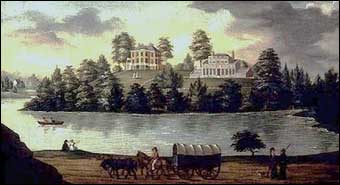
Lemon Hill, John Woodside 1807, Historical Society of Pennsylvania
LEMON HILL, ESTATE OF HENRY PRATT
This beautiful garden, so creditable to the owner, and even to the city of Philadelphia, is kept in perfect order at a great expense. Few strangers omit paying it a visit, a gratification which is afforded to them in the most liberal manner to the proprietor. Nor can any person of taste contemplate the various charms of this highly improved spot, without being in rapture with the loveliness of nature- everywhere around him, so chastely adorned by the hand of man.
Undoubtedly this is the best kept garden in Pennsylvania, and when associated with the green and hot house department, may be pronounced unrivalled in the Union. The gravel walks, espaliers, plants, shrubs, mounds, and grass plats, are dressed periodically and minutely.
... Along the walks, the flower borders are interspersed with Thunbergias, Eccremocarpus, Chelonias, Mimosas, &c. The Laurustinus, sweet Bay, English Laurel, Rosemary, Chinese privet, Myrtle, Tree Sage and South Sea Tea, stand among them, and bear the winter with a little straw covering. Even the Verbena triphylla, or Aloysia Citriodora, has survived through our cold season in Mr. Pratt's city garden; seven of these plants are evergreens, and if they become inured to our climate, they will add greatly to our ornamental shrubs.
The treasures contained in the hot and green houses are numerous. Besides a very fine collection of Orange, Lemon, Lime, Citron, Shaddock, Bergamot, Pomgranate and Fig trees in excellent condition and full of fruit, we notice with admiration the many thousand of exotics to which Mr. Pratt is annually adding. The most conspicuous among these, are the tea tree; the coffee tree - loaded with fruit; the sugar cane; the pepper tree, Banana, Plantain, Guva, Cherimona, Ficus, Mango, the Cacti in great splendour, some 14 feet high, and a gigantic Euphorbia Trigonia - 19 years old, and 13 feet high. The green Houses are 220 feet long by 16 broad; exhibiting the finest range of glass for the preservation of plants, on this continent.
Colonel Perkins, near Boston, has, it is true, a grapery and peach Espalier, protected by 330 feet of glass, yet as there are neither flues nor foreign plants in them, they cannot properly be called green houses, whereas Mr. Pratt's are furnished with the rarest productions of every clime, so that the committee places the conservatory of Lemon Hill at the very head of all similar establishments in this country.
There are some pretty bowers, summer houses, grottos and fish ponds in this garden -the latter well stored with gold and silver fish. The mansion house is capacious and modern, and the prospects, on all sides, extremely beautiful. In landscape gardening, water and wood are indispensable for picturesque effect; and here they are found distributed in just proportions with hill and lawn and buildings of architectural beauty, the whole scene is cheerfully animated by the brisk commerce of the river, and constant movement in the busy neighbourhood of Fairmount.
An engine for raising water to the plant houses, is sometimes put in operation. Mr. Pratt placed it here at a cost of three thousand dollars. The vegetable garden is well kept and is of suitable size. For many years the chief gardener was assisted by eleven or twelve labourers, he now employs only six; probably owing to the finished condition to which the proprietor had brought his grounds. The whole plot may contain 20 acres; Mr. Pratt has owned it 30 years or more. The superintendent aided by the liberal spirit of that gentleman, conducts his business with the skill and neatness, and may challenge any garden for minute excellence or general effect.

Room setting in the second floor Palladian hall

Views of Old Philadelphia, Watercolors by Benjamin R. Evans
Fiske Kimball became director of the Philadelphia Museum of Art in 1925. He restored the mansion in the eighteenth century manner. He and his wife Marie, were architectural historians, They lived in the mansion until 1955.
The Colonial Dames of America Chapter II took over the care of the property in 1957. In 1976 they were in charge of a major renovation project. They continue to preserve Lemon Hill for its historic splendor and important significance as a national treasure. thousands of visitors who tour the mansion as part of the historic house tours of Fairmount Park. Lemon Hill truly represents two-hundred years of splendor in the Park.
For the Holiday House Tour, the Weeders and Gardeners decorated the mansion with the theme "Jewels in the Park."Source: Text and Photos by Bryan Wright