Lemon Hill
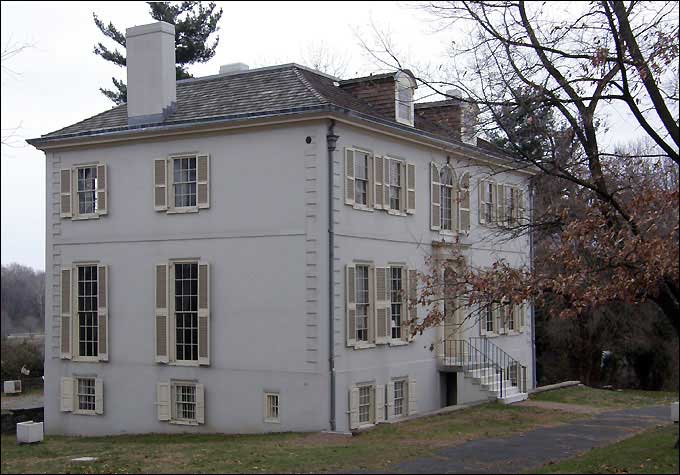
Exterior of Sweetbriar Mansion
John's son-in-law, Samuel Breck, was born 1771 in Boston to a father, Samuel Breck Sr. who was fiscal agent for the French forces during the Revolutionary War. Samuel Breck Jr. spent much of his childhood traveling abroad. He attended school more than four years in Soreze, France when he was eleven. He returned to Boston in 1787, but then went to England in 1790-1791. He came to Philadelphia with his parents in 1792. Philadelphia was enticing to them with the milder climate and lower taxes.

North Parlor room
There came out in Boston in the summer of 1792 a system of taxation the most iniquitous imaginable, which by its injustice drove from the town several of its richest inhabitants. It was bottomed principally on guess-work, and as the Yankees are no less privileged to guess than the Irish to speak twice, they made good use of their immunity on this occasion. After rating an inhabitant for watch where there were no watchmen, for lighting streets where there were no lamps, for municipal regulations in general where there was almost an entire absence of police, they put down under the head of "Faculty" just what they pleased, guessing this man to be worth so much, and that other so much, thus laying a heavy and ruinous tax upon him who lived liberally and spent his income amongst his fellow townsmen in acts of hospitality to them and to strangers; while the rich miser, who kept his money out of circulation, was deemed poor, and scarcely taxed at all. In this way they put down the item Faculty in my father's tax-bill at eleven hundred and twenty-five hard dollars for one year. The same thing happened to all the gentlemen who lived expensively. No redress could be had, and my father and mother, who had recently visited Philadelphia, concluded to remove to that city, where taxation was equal and where nothing but real estate was assessed. That city was, moreover, the seat of the Federal Government, and possessed the most refined society in the Union. The climate is more moderate than that of Boston. and my parents had been entertained there with universal kindness and hospitality. Orders were therefore given to purchase the house then numbered 321, Hjgh-street. It was of modern construction, with lofty ceilings, a front of thirty feet; a deep lot with coach-house and stables in the rear, and a carriage-way into Filbert-street. For this property my father paid eleven thousand dollars, and as soon as the purchase was made he transplanted his family for ever from his native town to the beautiful city of Philadelphia. This event was forced upon him, but neither he nor my mother ever regretted the removal, notwithstanding he lost fifty thousand dollars on the sale of his house and gardens, which he sold to my uncle Andrews for eight thousand five hundred dollars, who resold them for about sixty thousand. The whole of our taxes in Philadelphia were fifty-five dollars, being just about the amount of the Boston collector's commissions on my father's taxes in that town.

Another view inside the North Parlor
The mansion on this estate I built in 1797. It is a fine stone house, rough-cast,fifty-three feet long, thirty-eight broad, and three stories high, having out-buildings of every kind suitable for elegance and comfort. The prospect consists of the river, animated by its great trade carried on in boats of about thirty tons, drawn by horses; of a beautiful sloping lawn, terminating at that river, now nearly four hundred yard wide opposite the portico; of side-screen woods; of gardens, green-house, etc. Sweetbrier is the name of my villa.

Sweetbriar Hall with a Christmas tree in front of the back door.
Samuel Breck became a state senator from 1832 to 1834 and member of the 18th Congress from 1823 to 1825. During his tenure as state senator, he wrote the legislation that addressed the need for public schooling in Pennsylvania. In his Diary he mentions notable figures in history like Joseph Bonaparte, Dr. Benjamin Rush, Robert Morris, General Marquis de Lafayette, John James Audubon. Here are a few excerpts from his Diary on a few of these people:
GENERAL MARQUIS DE LAFAYETTE Last evening Judge Peters called upon me, long after dark, coming from the dinner given to Mr. Rush, late minister to the British Court, to request me to breakfast with him this day at his house (Belmont in my neighbourhood) in company with Genl. Lafayette. The heat was then intense and the glass had been for many days above 90 degrees; yet, to meet that great man, I arose early, and met at the Judge’s beautiful seat the following company: General Lafayette; George Washington Lafayette, his son; Monsieur La Vasseur, his Secretary, and Monsieur Le Compte de Lyon, who accompanies him as a friend; Chief Justice Tilghman; Mr. Nicholas Biddle, President of the Bank of the U. S.; Mr. Thomas Biddle; Mr. Roberts Vaux; Mr. R. Haynes; Mr. Warder; Mr. Richard Peters, Jr.; Mr. Joseph L. Lewis (chairman of the Committee of City Councils appointed to attend upon the General during his visit to Phila.); a French count, whose name I forgot, but who is the son of the Prime Minister of the King of Sardinia; & some other persons whose names I do not recollect. We had a splendid dejeune a lafourchette after which the General and his suite did me the honor to pay me a visit of 3/4 of an hour.I asked this illustrious man to dine with me, when disengaged. He said he could give me only Sunday, the day previous to his departure from Pennsylvania.
A tea table decorated in the Etruscan Room
July 23, 1825
The glass at 94, higher than I have ever known it in my hall (a fine open space for every breeze that blows). I went to town to prepare for my greatly distinguished guest, who is to dine with me tomorrow.
July 25, 1825
General Lafayette did me the honor to dine with me, in company with Messrs. George W. Lafayette, his son, Mr. Levasseur, Mr. Lyon, Mr. Nicholas Biddle, Judge Peters, Mr. Wm. Meredith, Mr. Wm. M. Meredith, Mr. C. J. Ingersoll, Mr. Henry Wikoff, Mr. Joseph L. Lewis.
In order to give the party a good dinner, and to supply the lamentable deficiency of our common cooks, I had on Friday called on the celebrated French cook (Dupony) and begged him to furnish me with a dinner, and on a confectioner, requesting her to provide a dessert.
Having made these arrangements for a dinner of 20 covers, I supposed every thing would go on very well; what then was my disappointment at past eleven o'clock to learn that Dupony, the cook, had died that morning at 6 o'clock.
With the weather excessively hot, on a Sunday, and 20 people expected at dinner, this was an appalling piece of news; but it so happened that [Charles] Mercer the confectioner took some interest in the entertainment, and sent me out cooks who got thro’ the business very well, and our dinner went off in good style.ROBERT MORRIS
Among the very leading men in all respects at that time was Robert Morris. History has not yet done justice to this great man's noble exertions during our Revolutionary War. His patriotism was superior to the fears which too often seize upon the wealthy in moments of civil commotion, and he freely risked everything in the good cause. Being at home in Philadelphia, he did the honors of the city by a profuse, incessant and elegant hospitality. Our first American prelate, the Right Reverend Bishop White (now living, this 14th December, 1834, aged nearly eighty-eight), was connected with Morris, who married his sister, a lady of refined and dignified manners, and suited in all respects for the centre of the fashionable circle in which she moved. There was a luxury in the kitchen, table, parlor and street equipage of Mr. and Mrs. Morris that was to be found nowhere else in America. Bingham's was more gaudy, but less comfortable. It was the pure and unalloyed which the Morrises sought to place before their friends, without the abatements that so frequently accompany the displays of fashionable life. No badly-cooked or cold dinners at their table ; no pinched fires upon their hearths ; no paucity of waiters; no awkward loons in their drawing-rooms. We have no such establishments now. God in his mercy gives us plenty of provisions, but it would seem as if the devil possessed the cooks. Servants in those days looked better than now, because they were uniformly dressed, and a corresponding neatness was seen in the carriages and horses. Now-a-days, if a man strives to distinguish himself, either at home or abroad, by a superior style of living, he is branded an aristocrat. This nonsense, however, is wearing away.
Morris embarked afterward in land speculations that would have given him a princely fortune had he been able to wait a few years, but his means were too feeble. He succumbed, and came very near dying in prison. His country, that owed him so much, suffered him to lie in jail more than four years. I visited that great man in the Prune street debtors' apartment, and saw him in his ugly whitewashed vault. In Rome or Greece a thousand statues would have honored his mighty services. In a monarchy, such as England or any other in Europe, he would have been appropriately pensioned; in America, republican America, not a single voice was raised in Congress or elsewhere in aid of him or his family, and after his death his widow would have been left destitute had not Gouverneur Morris made it a condition with M. le Ray de Chaumont, who had purchased some of the New York lands of Robert, that the widow should not sign the deeds unless the purchaser secured to her an annuity of sixteen hundred dollars. This was done, and upon it Mrs. Morris subsisted until her death.


Decorations adorning the bannister going the the second floor
Samuel Breck sold Sweetbriar to William S. Torr in 1838 who may have used it as a tavern based upon an 1859 survey. Fairmount Park bought the property in 1869. It bordered the Centennial Exposition grounds of 1876. As other mansions, is was used as a restaurant in 1877. Its first restoration occurred in 1932 and was undertaken by the Junior League. By 1976 the city restored the property again. Currently it is maintained by the The Modern Club Of Philadelphia, Inc., in conjunction with Fairmount Park Commission.
The theme for the Holiday House Tour was "The Midas Touch." with the house being decorated by the Bala Garden Club and the Modern Club. A decorated tree stood at the end of the hall in front of the main entry door. The Etruscan Room has a beautiful Federal Mansion with period furniture decorating the area. The bannister heading up towards the second floor is decorated with gold Christmas balls and garland.
Source: Text and Photos by Bryan Wright