Ironmaster's Mansion built in three stages beginning in 1770
Hopewell Village was a small self-sustaining village in colonial times which was built around a cold-blast, charcoal-burning iron furnace. The community life was in some respects similar to that of the small feudal manors of medieval Europe and was largely self-sustaining. Little had changed of the village from colonial times up through most of the nineteenth century.

The Cast House where moulder cast iron into stove plates and other products
During the Revolutionary War, Colonel Bird was given the impossible order of getting food to General Washington's starving troops at Valley Forge. This task General Mifflin had failed to do earlier. Colonel Bird managed to float 1,000 barrels of flour from his own water grist mills in Birdsboro which were stored in Reading down the Schuylkill River in the dead of winter.
In 1772 Bird was the highest taxpayer in Berks County. Mark Bird also built Seyfert Forge. The Birdsboro forges eventually came under his control, along with a slitting mill. His inventory in 1779 was listed as:
10,883 acres of land, 1 furnace, 2 forges and two-thirds interest in Spring Forge, 1 slitting mill, 1 saw mill, 2 pleasure carriages, 28 horses, 30 working oxen, 18 horned cattle, 12 negroes, 1 servant, and £3,767 cash.
In 1776, Bird was elected a member of the Pennsylvania Assembly and of the Provincial Convention of 1776. He was also appointed a Judge of the Berks County Court.

Pastoral Scene at Hopewell. The blacksmith shop is in the background

Inside the blacksmith shop
A clear-cut paternalistic hierarchy did exist within the village society. The ironmaster sat at the top of that social class The furnace clerk was second only to the ironmaster in importance. He kept the books, and acted as paymaster along with managing the company store. The clerk managed the furnace in absence of the ironmaster and often lived in the ironmaster's mansion.

Tunnel Head inside the Cast House
Shortly after the Revolutionary War, a flood on Hay Creek ruined much of his iron works and the the depression that ensued began Colonel Bird's financial troubles. Like so many others, Bird fell into the category of Revolutionary War veteran that was not reimbursed by the newly formed government. In 1778 and 1780, there were orders issued by the Continental Congress to reimburse Bird sums of $50,000 and $125,691. It is obvious Bird was never able to collect on these orders. By 1780-1781 part of the ironworks was out of operation completely. Tax records from 1782-1784 showed Bird pay one quarter of the taxes he paid when the furnace was fully in operation. Between April 8 and September 14, 1784, only 196 tons of pig iron and 14-1/2 tons of finished castings were produced, and by 1785 there is record of only 134 tons of pig iron and 30-1/2 tons of finished castings.
On September 19, 1783, the Continental Congress received a memorial from Colonel Bird seeking partial payment from the government by taking ownership of the Great Chain which was stretched across the Hudson River at West Point to obstruct British navigation. His request was denied on September 29, 1783:
On the report of a committee, consisting of M.Y. [Abraham] Clark, M.V. [Thomas] Fitzsimmons and M.v. [Benjamin] Hawkins, to whom was referred a memorial of Mark Bird, requesting that the chain made for the defence of Hudson's river, may be delivered to him at a reasonable price:
The Committee consisting of Mr [Abraham] Clark, Mr [Thomas] Fitzsimmons and Mr [Benjamin] Hawkins, to whom were referred the memorial of Mark Bird report.
That as the memorialist being a creditor of the United States may obtain a settlement of his accounts in common with others under similar circumstances, it is unnecessary to give any particular order in his behalf.
With respect to the chain made for the defence of Hudson's river, your committee are of opinion it will be improper to dispose of the same at this time; should such a measure be judged proper hereafter the product of such sale ought to be for general use, and not for the benefit of any particular creditor.

Two colonial men talking outside of the blacksmith shop, Notice the clay tiles on the roof of the shop. When the shop caught on fire, some of the tiles needed replaced. 200 years later the same mold was found to make new tiles to replicate the old tiles
Hopewell Furnace was transferred to Cadwallader Morris and James Old who were both notable ironmasters. Cadwallader's brother, Benjamin Morris took over the deed in 1791 but by 1793 the property was returned to James Old with Morris holding the mortgage. Hopewell Furnace was operated under the name of James Old & Co. In the next few years the furnace realized some recovery but Old was not able to make payments. By 1800, Old gave the title to Benjamin Morris who then sold it for £10,000 to Matthew Brooke Jr. of Berks County and his brother, Thomas Brooke of Montgomery County along with their brother-in-law, Daniel Buckley of Lancaster County.
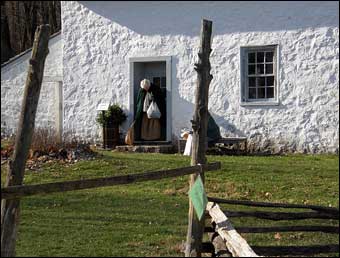
Outside of a tenant house which was decorated to reflect the year 1795
Clement began his iron career at the age of 16 in 1804 as assistant clerk at Hopewell Furnace. He worked part time supervising the filing of the blast furnace. He became a clerk at the age of 20. Eventually he became caretaker of the property and managed the stamping mill. His salary as ironmaster was $600 a year and free living in the ironmaster's mansion. In 1827 he became part owner.
The Federal Government improved transportation substantially on roads and turnpikes and the Canal Era emerged which accelerated the shipping of products. After the War of 1812, Congress enacted protective tariffs to help industries from foreign competition. With the improvements and producing more castings and less pig iron, Clement was able to produce a substantial profit.

Coal loaded in a coal car
The decline if the Hopewell Furnace began with a five year depression which started in 1837. The introduction of the hot blast method in the smelting of iron in the following year, making possible the substitution of coke for charcoal accelerated the end of the charcoal burning furnace. The colonial era of the mighty iron forge industry was coming to an end. Hopewell eventually was blown out for the last time in 1883 and was one of the last cold-blast charcoal burning furnaces. It sustained 113 years of activity.

Der Belsnickel sneaking in the Cast House prior to the children arriving
During the operation of Hopewell Furnace in the nineteenth century few gifts were given. The village store did not have shelves stocked with special Christmas items. However, some luxury foods were available such as sugar, coffee, tea, and cranberries. Molasses or sugar cakes shaped into designs may have been given to children.

A young colonial lady brushes her loving horse
In the Cast House, Der Belsnickel arrived to visit with everyone as he would have done in 1835. The Hopewell Furnace is located in the Cast House. The Office/Store Building was a representation of the hub of the village in 1855. Consumables were available for sale for the workers at Hopewell, as well as the visitors this day.

A gentleman from 1865 smoking his pipe and enjoying the fire inside the Boarding House

Inside the Big House or Ironmaster's Mansion which was decorated for Christmas in the 1875 tradition. Flutists Alannah Sellman and Rachael Smith played Christmas music
Hopewell Furnace National Historical Site is Located off Route 345 near French Creek State Park and below the town of Birdsboro. Visit their website for the hours of operation and special events. Source: Text and photos by Bryan Wright