The next house we visited was Mount Pleasant, an architectural masterpiece with a 24 month, $1.6 million restoration project completed in 2006 by the Philadelphia Museum of Art. In order to replace some of the rotted wood in the beams, tulip poplar trees were cut down in Lancaster County, custom sawn, and kiln dried. The first owner was Captain John Macpherson who took command of the 20 gun privateer Britannia in 1757. With a lost arm and the sufferings of nine other wounds, Macpherson captured several rich prizes. With part of his spoils, he built his elegant Georgian home between 1762 and 1765 on the banks of the Schuylkill and named it Clunie after his ancestral home in Scotland. Eventually he changed the name to Mount Pleasant. John Adams visited Mount Pleasant in October 1775 and commented that the home "had the most elegant seat in Pennsylvania."
The dinner table set up to portray the Man's World in the 18th century. Notice the beautiful carvings by Martin Jugiez on the mantle
Captain John Macpherson employed Thomas Nevell (1721-1792), an apprentice of Edmund Woolley, the builder of Independence Hall as the builder and architect. Macpherson sold Nevell a copy of Abraham Swan's A Collection of Designs in Architecture (London 1775). Nevell was first employed in building a fine staircase with a double twist for Edward Shippen, a wealthy judge. Nevell eventually started the nation's first architectural school. For the 1786 Rule Book, one of the earliest works on American architecture, Nevell contributed 37 drawings to the volume.
For Mount Pleasant, Thomas Nevell hired the best carvers, turners, and carpenters in Philadelphia. The best carver by choice was Martin Jugiez who was credited with the elaborate wood carvings in the dining room, second story hall and drawing room. His style of C-scrolls, leaves and buds, and flowers is easily attributed to him. Jugiez went on to work at Cliveden and priceless caved Chippendale furniture. The hallway woodwork design matches the hall in the State House. Noticeable in other rooms are the Greek designs. Palladian windows, a roof balustrade, and flanking outbuildings all add to the symmetry design that the Georgian architecture illustrates.
Mount Pleasant's Parlor Room
In the 1770's Captain Mcpherson fell into some financial hardships and leased Mount Pleasant out to Don Juan de Merailles, the the Spanish ambassador. Finally in 1779 Benedict Arnold bought Mount Pleasant as a gift to his new bride, Peggy Shippen, the daughter of Edward Shippen who was mentioned earlier. However, the couple never did live in Mount Pleasant do to the treason charges placed on Benedict Arnold in the fall of 1780.
Edward Shippen bought the property in 1784 and in 1791 Jonathan Williams, a great-nephew of Benjamin Franklin and first superintendent of West Point purchased the property at a sheriff's sale. General Williams died in 1815 and Mount Pleasant was inherited by his son Henry Williams along with thirty-eight acres. By the 1840s, portions of the land were sold to new industries such as The Knickerbocker Ice Company of Philadelphia and brewers of German lager beer began to lease acreage of land from WIlliams. By 1854. Williams sold thirty acres a group of investors who established the Granite Land Company.
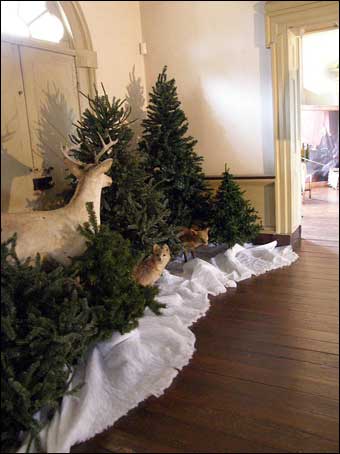
An outdoor nature scene to represent the Man's World in the 18th century
Mount Pleasant was finally sold to Fairmount Park. It was used as a dairy in 1878 selling milk until 1900. In 1906 it became a headquarters for La Moviganta Klubo, a ladies' automobile club.
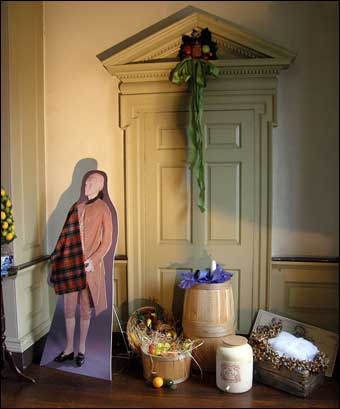
The theme for the Holiday Tour was "Scenes from a Man's World." Wine, spirits, furs, porcelain, and exotic foods were represented in the theme of Mount Pleasant. It is maintained by the Philadelphia Museum of Art.



 Laurel Hill Mansion