The Stage Coach
Lo, now is come our joyfuls't feast!WHEN I awoke the next morning, it seemed as if all the events of the preceding evening had been a dream, and nothing but the identity of the ancient chamber convinced me of their reality. While I lay musing on my pillow, I heard the sound of little feet pattering outside of my door, and a whispering consultation. Presently a choir of small voices chaunted forth an old Christmas carol, the burden of which was
Let every man be jolly,
Eache roome with yvie leaves is drest,
And every post with holly.
Now all our neighbour's chimneys smoke
And Christmas blocks are burning;
Their ovens they with bak’t meats choke,
And all their spits are turning.
Without the door let sorrow lie,
And if, for cold, it hap to die,
Wee'le bury't in a Christmas pye,
And ever more be merry.WITHERS' JUVENILIA.
Rejoice, our Saviour he was bornI rose softly, slipt on my clothes, opened the door suddenly, and beheld one of the most beautiful little fairy groups that a painter could imagine. It consisted of a boy and two girls, the eldest not more than six, and lovely as seraphs. They were going the rounds of the house, singing at every chamber door, but my sudden appearance frightened them into mute bashfulness. They remained for a moment playing on their lips with their fingers, and now and then stealing a shy glance from under their eyebrows, until as if by one impulse, they scampered away, and as they turned an angle of the gallery, I heard them laughing in triumph at their escape.
On Christmas day in the morning.
Every thing conspired to produce kind and happy feelings in this strong hold of old fashioned hospitality. The window of my chamber looked out upon what in summer would have been a beautiful landscape. There was a sloping lawn, a fine stream winding at the foot of it, a tract of park beyond, with noble clumps of trees, and herds of deer. At a distance was a neat hamlet, with the smoke from the cottage chimneys hanging over it; and a church with its dark spire in strong relief against the clear cold sky. The house was surrounded with evergreens, according to the English custom, which would have given almost an appearance of summer; but the morning was extremely frosty; the light vapour of the preceding evening had been precipitated by the cold, and covered all the trees and every blade of grass with its fine chrystalizations. The rays of a bright morning sun had a dazzling effect among the glittering foliage. A robin perched upon the top of a mountain ash that hung its clusters of red berries just before my window, was basking himself in the sunshine, and piping a few querulous notes, and a peacock was displaying all the glories of his train, and strutting with the pride and gravity of a Spaniard on the terrace walk below.
I had scarce dressed myself, when a servant appeared to invite me to family prayers. He showed me the way to a small chapel in the old wing of the house, where I found the principal part of the family already assembled in a kind of gallery, furnished with cushions, hassocks, and large prayer books; the servants were seated on benches below. The old gentleman read prayers from a desk in front of the gallery, and master Simon acted as clerk and made the responses, and I must do him the justice to say that he acquitted himself with great gravity and decorum.
The service was followed by a Christmas carol, which Mr. Bracebridge himself had constructed from a poem of his favourite author, Herrick; and it had been adapted to an old church melody by master Simon. As there were several good voices among the household, the effect was extremely pleasing; but I was particularly gratified by the exaltation of heart, and sudden sally of grateful feeling, with which the worthy squire delivered one stanza, his eye glistening, and his voice rambling out of all the bounds of time and tune.
'Tis thou that crown'st my glittering hearthI afterwards understood that early morning service was performed on every Sunday and saint's day throughout the year, either by Mr. Bracebridge or some member of the family. It was once almost universally the case at the seats of the nobility and gentry of England, and it is much to be regretted that the custom is falling into neglect; for the dullest observer must be sensible of the order and serenity prevalent in those households, where the occasional exercise of a beautiful form of worship gives, as it were, the key note to every temper, and attunes every spirit to harmony.
With guiltlesse mirth,
And giv'st me Wassaile Bowles to drink
Spic'd to the brink.
Lord, 'tis thy plenty-dropping hand
That soiles my land;
And giv'st me, for my bushell sowne,
Twice ten for one.
After breakfast, I walked about the grounds with Frank Bracebridge and Master Simon, or Mr. Simon, as he was called by every body but the squire. We were escorted by a number of gentleman-like dogs, that seemed loungers about the establishment, from the frisking spaniel to the steady old stag hound, the last of which was of a race that had been in the family time out of mind: they were all obedient to a dog whistle which hung at Master Simon's button hole, and in the midst of their gambols would glance an eye occasionally upon a small switch he carried in his hand.
The old mansion had a still more venerable look in the yellow sunshine than by pale moonlight; and I could not but feel the force of the squire's idea, that the formal terraces, heavily moulded ballustrades, and clipped yew trees, carried with them an air of proud aristocracy. There appeared to be an unusual number of peacocks about the place, and I was making some remarks upon what I termed a flock of them that were basking under a sunny wall, when I was gently corrected in my phraseology by Master Simon, who told me that, according to the most ancient and approved treatise on hunting, I must say a muster of peacocks. “In the same way,” added he, with a slight air of pedantry, “we say a flight of doves or swallows, a bevy of quails, a herd of deer, of wrens or cranes, a skulk of foxes, or a building of rooks.” He went on to inform me that, according to Sir Anthony Fitzherbert, we ought to ascribe to this bird “both understanding and glory; for, being praised, he will presently set up his tail, chiefly against the sun, to the intent you may the better behold the beauty thereof. But at the fall of the leaf, when his tail, falleth, he will mourn and hide himself in corners, till his tail come again as it was.”
I could not help smiling at this display of small erudition on so whimsical a subject; but I found the peacocks were birds of some consequence at the hall; for Frank Bracebridge informed me that they were great favourites with his father, who was extremely careful to keep up the breed, partly because they belonged to chivalry, and were in great request at the stately banquets of the olden time; and partly because they had a pomp and magnificence about them, highly becoming an old family mansion. Nothing, he was accustomed to say, had an air of greater state and dignity than a peacock perched upon an antique stone ballustrade.
Master Simon had now to hurry off, having an appointment at the parish church with the village choristers, who were to perform some music of his selection. There was something extremely agreeable in the cheerful flow of animal spirits of the little man; and I confess I had been a somewhat surprised at his apt quotations from authors, who certainly were not in the range of every day reading. I mentioned this last circumstance to Frank Bracebridge, who told me with a smile that Master Simon's whole stock of erudition was confined to some half a dozen old authors, which the squire had put into his hands, and which he read over and over, whenever he had a studious fit, as he sometimes had of a rainy day, or a long winter evening. Sir Anthony Fitzherbert's book of Husbandry; Markham's Country Contentments; the Tretyse of Hunting, by Sir Thomas Cockaine, Knight; Isaac Walton's Angler, and two or three more such ancient worthies of the pen, were his standard authorities; and, like all men who know but a few books, he looked up to them with a kind of idolatry, and quoted them on all occasions. As to his songs, they were chiefly picked out of old books in the squire's library, and adapted to tunes that were popular among the choice spirits of the last century. His practical application of scraps of literature, however, had caused him to be looked upon as a prodigy of book knowledge by all the grooms, huntsmen, and small sportsmen of the neighbourhood.
While we were talking, we heard the distant toll of the village bell, and I was told the squire was a little particular in having his household at church on Christmas morning; considering it a day of pouring out of thanks and rejoicing, for, as old Tusser observed,
At Christmas be merry, and thankful withal,“If you are disposed to go to church,” said Frank Bracebridge, “I can promise you another specimen of my cousin Simon’s musical achievements. As the church was destitute of an organ, he has formed a band from the village amateurs, and established a musical club for their improvement; and for a choir, he has sought out all the ‘deep, solempe mouths,' and 'loud ringing mouths' among the country bumpkins; and for 'sweete mouths,' he has culled with curious taste among the prettiest lasses in the neighbourhood, though these last, he affirms, are the most difficult to keep in tune, your pretty female singer being exceedingly wayward and capricious, and very liable to accident.”
And feast thy poor neighbours, the great with the small.
Being habitually a little of what is called a church going man, I readily acceded to Bracebridge's proposition. As the morning, though frosty, was remarkably fine and clear, the most of the family walked to the church, which was a very old building of grey stone, and stood near a village, about half a mile from the park gate. Adjoining it was a low snug parsonage, which seemed coeval with the church. The front of it was perfectly matted with a yew tree, that had been trained against its walls; through the dense foliage of which, apertures had been formed to admit light into the small antique lattices. As we passed this sheltered nest, the parson issued forth, and preceded us.
I had expected to see a sleek well-conditioned pastor, such as is often found in a snug living in the vicinity of a rich patron's table, but I was disappointed. The parson was a little, meagre, black-looking man, with a grizzled wig that was too wide, and stood off from each ear, so that his head seemed to have shrunk away within it, like a dried filbert in its shell. He wore a rusty coat with great skirts and pockets that would have held the church bible and prayer book; and his small legs seemed still smaller, from being planted in large shoes, decorated with enormous buckles.
I was informed by Frank Bracebridge, that the parson had been a chum of his father's at Oxford, and had received this living shortly after the latter had come to his estate. He was a complete black-letter hunter, and would scarcely read a work printed in the roman character. The editions of Caxton and Wynkin de Worde were his delight, and he was indefatigable in his researches after such old English writers as have fallen into oblivion from their worthlessness. In deference, perhaps, to the notions of Mr. Bracebridge, he had made diligent investigations into the festive rites and holyday customs of former times, and had been as zealous in the inquiry, as if he had been a boon companion; but it was merely with that plodding spirit, with which men of adust temperament follow up any tract of study, merely because it is denominated learning, indifferent to its intrinsic nature, whether it be the illustration of the wisdom or of the ribaldry and obscenity of antiquity. He had pored over these old volumes so intensely, that they seemed to have been reflected into his countenance, which, if the face be, indeed, an index of the mind, might be compared to a title page of black letter.
On reaching the church porch, we found the parson rebuking the gray-headed sexton for having used misletoe among the greens with which the church was decorated. It was, he observed, an unholy plant; profaned by having been used by the druids in their mystic ceremonies, and though it might be innocently employed in the festive ornamenting of halls and kitchens, yet it had been deemed by the fathers of the church as unhallowed, and totally unfit for sacred purposes. The poor sexton therefore was obliged to strip down a great part of the humble trophies of his taste, before the parson would consent to enter upon the service of the day.
The interior of the church was venerable, but simple: on the walls were several mural monuments of the Bracebridges; and just beside the altar was a tomb of ancient workmanship, on which lay the effigy of a warrior in armour, with his legs crossed, a sign of his having been a crusader. I was told it was one of the family who had signalized himself in the holy land, and the same whose picture hung over the fire place in the hall.
During service, master Simon stood up in the pew, and repeated the responses very audibly; evincing that kind of ceremonious devotion punctually observed by a gentleman of the old school, and a man of old family connexions. I observed, too, that he turned over the leaves of a folio prayer book with something of a flourish, possibly to show off an enormous seal ring which enriched one of his fingers, and had the look of a family relique. But he was evidently most solicitous about the musical part of the service, keeping his eye fixed intently on the choir, and beating time with much gesticulation and emphasis.
The orchestra was in a small gallery, and presented a most whimsical grouping of heads, piled one above the other, among which I particularly noticed that of the village taylor, a pale fellow with a retreating forehead and chin, who played on the clarionet, and seemed to have blown his face to a point; and there was another, a short pursy man, stooping and labouring at a bass viol, so as to show nothing but the top of a round bald head, like the egg of an ostrich. There were two or three pretty faces among the female singers, to which the keen air of a frosty morning had given a bright rosy tint; but the gentlemen choristers had evidently been chosen, like old Cremona fiddles, more for tone than looks; and as several had to sing from the same book, there were clusterings of odd physiognomies, not unlike those groups of cherubs we sometimes see on country tombstones.
The usual services of the choir were managed tolerably well, the vocal parts generally lagging a little behind the instrumental, and some loitering fiddler now and then making up for lost time by travelling over a passage with prodigious celerity, and clearing more bars than the keenest fox hunter, to be in at the death. But the great trial was an anthem that had been prepared and arranged by master Simon, and on which he had founded great expectations. Unluckily, there was a blunder at the very outset; the musicians became flurried; master Simon was in a fever; every thing went on lamely and irregularly until they came to a chorus beginning “Now let us sing with one accord,” which seemed to be a signal for parting company: all became discord and confusion, each shifted for himself, and got to the end as well, or, rather, as soon as he could, excepting one old chorister in a pair of horn spectacles, bestriding and pinching a long sonorous nose, who, happening to stand a little apart, and being wrapped up in his own melody, kept on a quavering course, wriggling his head, ogling his book, and winding all up by a nasal solo of at least three bars duration.
The parson gave us a most learned sermon on the rites and ceremonies of Christmas, and the propriety of observing it, not merely as a day of thanksgiving, but of rejoicing; supporting the correctness of his opinions by the earliest usages of the church, and enforcing them by the authorities of Theophilus of Cesarea, St. Cyprian, St. Chrysostom, St. Augustine, and a cloud more of saints and fathers, from whom he made copious quotations. I was a little at a loss to perceive the necessity of such a mighty array of forces to maintain a point which no one present seemed inclined to dispute; but I soon found the good man had a legion of ideal adversaries to contend with, having, in the course of his researches on the subject of Christmas, got completely embroiled in the sectarian controversies of the revolution, when the puritans made such a fierce assault upon the ceremonies of the church, and poor old Christmas was driven out of the land by proclamation of Parliament. The worthy parson lived but with times past, and knew but little of the present. Shut up among worm- eaten tomes in the retirement of his little antiquated study, the pages of old times were to him as the gazettes of the day; and as to the era of the revolution, it was mere modern history. He forgot that nearly two centuries had elapsed since the fiery persecution of poor Mince-pie throughout the land; when plum-porridge was denounced as “mere popery, and roast beef as antichristian;” and that Christmas had been brought in again triumphantly with the merry court of King Charles at the restoration. He kindled into warmth with the ardour of his contest, and the host of imaginary foes with whom he had to combat; had a stubborn conflict with old Prynne and two or three more forgotten champions of the round heads, on the subject of Christmas festivity; and concluded by urging his hearers, in the most solemn and impressive manner, to stand to the traditionary customs of their fathers, and feast and make merry on this joyful anniversary of the church.
I have seldom known a sermon attended apparently with more immediate effects; for on leaving the church the congregation seemed one and all possessed with the gayety of spirit so earnestly enjoined by their pastor. The elder folks gathered in knots in the church yard, greeting and shaking hands, and the children ran about crying Ule! Ule! and repeating some uncouth rhymes, which the parson, who had joined us, informed me had been handed down from days of yore. The villagers doffed their hats to the squire as he passed, giving him the good wishes of the season with every appearance of heartfelt sincerity, and were invited by him to the hall, to take something to keep out the cold of the weather; and I heard blessings uttered by several of the poor, which convinced me that, in the midst of his enjoyments, the worthy old cavalier had not forgotten the true Christmas virtue of charity.
On our way homeward, his heart seemed overflowing with generous and happy feelings. As we passed over a rising ground which commanded something of a prospect, the sounds of rustic merriment now and then reached our ears; the squire paused for a few moments, and looked around with an air of inexpressible benignity. The beauty of the day was, of itself, sufficient to inspire philanthropy. Notwithstanding the frostiness of the morning, the sun in his cloudless journey had acquired sufficient power to melt away the thin covering of snow from every southern declivity, and to bring out the living green which adorns an English landscape even in mid winter. Large tracts of smiling verdure, contrasted with the dazzling whiteness of the shaded slopes and hollows. Every sheltered bank, on which the broad rays rested, yielded its silver rill of cold and limpid water, glittering through the dripping grass; and sent up slight exhalations to contribute to the thin haze that hung just above the surface of the earth. There was something truly cheering in this triumph of warmth and verdure over the frosty thraldom of winter: it was, as the squire observed, an emblem of Christmas hospitality breaking through the chills of selfishness, and thawing every heart into a flow. He pointed with pleasure to the indications of good cheer that were reeking from the chimneys of the comfortable farm-houses, and low thatched cottages. “I love,” said he, “to see this day well kept by rich and poor; it is a great thing to have one day in the year at least, when you are sure of being welcome wherever you go, and having, as it were, the world all thrown open to you; and I am almost disposed to join with poor Robin, in his malediction on every churlish enemy to this honest festival.”
Those who at Christmas do repineThe squire went on to lament the deplorable decay of the games and amusements which were once prevalent at this season among the lower orders, and countenanced by the higher. When the old halls of castles and manor houses were thrown open at daylight; the tables covered with brawn, and beef, and humming ale; the harp and the carol resounded all day long, and rich and poor were alike welcome to enter and make merry. “Our old games and local customs,” said he, “ had a great effect in making the peasant fond of his home, and the promotion of them by the gentry made him fond of his lord. They made the times merrier, and kinder, and better, and I can truly say with one of our old poets,
And would fain hence despatch him,
May they with old duke Humphry dine,
Or else may Squire Ketch catch 'em.
I like them well—the curious preciseness“The nation,” continued he, “is altered; we have almost lost our simple, true hearted peasantry. They have grown asunder from the higher classes, and seem to think their interests are separate. They have become too knowing, and begin to read newspapers, listen to alehouse politicians, and talk of reform. I think one mode to keep them in good humour in these hard times, would be for the nobility and gentry to pass more time on their estates, mingle more among the country people, and set the merry old English games going again.”
And all pretended gravity of those
That seek to banish hence these harmless sports,
Have thrust away much ancient honesty.
Such was the good squire's project for mitigating public discontent: and, indeed, Frank Bracebridge informed me that the old gentleman once attempted to put his doctrine in practice, and a few years since kept open house during the holydays in the old style. The country people, however, did not understand how to play their parts in the scene of hospitality: many uncouth circumstances occurred; the manor was overrun by all the vagrants of the country, and more beggars drawn into the neighbourhood than the parish officers could get rid of in a year. Since then, he had con- tented himself with inviting the decent part of the neighbouring peasantry to call at the hall on Christmas day, and distributing beef, and bread, and ale, among the poor, that they might make merry in their own dwellings.
We had not been long home when the sound of music was heard from a distance. A band of country lads, in white shirts, fancifully tied with ribands, their hats decorated with greens, and clubs in their hands, were seen advancing up the avenue, followed by a large number of villagers and peasantry. They stopped before the hall door, where the music struck up a peculiar air, and the lads performed a curious and intricate dance, advancing, retreating, and striking their clubs together, keeping exact time to the music; while one, whimsically crowned with a fox's skin, the tail of which flaunted down his back, kept capering round the skirts of the dance, and rattling a Christmas box with many antic gesticulations.
The squire eyed this fanciful exhibition with great interest and delight, and gave me a full account of its origin, which he traced to the times when the Romans held possession of the island, plainly proving that this was a lineal descendant of the sword dance of the ancients. “It was now,” he said, “nearly extinct, but he had accidentally met with traces of it in the neighbourhood, and had encouraged its revival, though, to tell the truth, it was too apt to be followed up by rough cudgel play, and broken heads, in the evening.”
After the dance was concluded, the whole party was entertained with brawn and beef, and stout home brewed. The squire himself mingled among the rustics, and was received with awkward demonstrations of deference and regard. It is true, I perceived two or three of the younger peasants, as they were raising their tankards to their mouths, when the squire's back was turned, making something of a grimace, and giving each other the wink, but the moment they caught my eye they pulled grave faces, and were exceedingly demure. With master Simon, however, they all seemed more at their ease. His varied occupations and amusements had made him well known throughout the neighbourhood. He was a visiter at every farm house and cottage, gossipped with the farmers and their wives, romped with their daughters, and like that type of a vagrant bachelor, the humble bee, tolled the sweets from all the rosy lips of the country round.
The bashfulness of the guests soon gave way before good cheer and affability. There is something genuine and affectionate in the gayety of the lower orders, when it is excited by the bounty and familiarity of those above them; the warm glow of gratitude enters into their mirth, and a kind word, and a small pleasantry frankly uttered by a patron, gladdens the heart of the dependant more than oil and wine. When the squire had retired, the merriment increased, and there was much joking and laughter; particularly between master Simon and a hale ruddy faced white headed farmer, who appeared to be the wit of the village, for I observed his companions all waited with open mouths for his retorts, and burst into a gratuitous laugh before they could well understand them.
Indeed, the whole house seemed abandoned to merriment: As I passed to my room to dress for dinner, I heard the sound of music in a small court, and looking through a window that commanded it, I perceived a band of wandering musicians with pandean pipes and tambourine: a pretty coquettish housemaid was dancing a jig with a smart country lad, while several of the other servants were looking on. In the midst of her sport the girl caught a glimpse of my face at the window, and colouring up, ran off with an air of roguish affected confusion.
I had finished my toilet, and was loitering with Frank Bracebridge in the library, when we heard a distant thwacking sound, which he informed me was a signal for the serving up of the dinner. The squire kept up old customs in kitchen as well as hall, and the rolling pin struck upon the dresser by the cook, summoned the servants to carry in the meats.
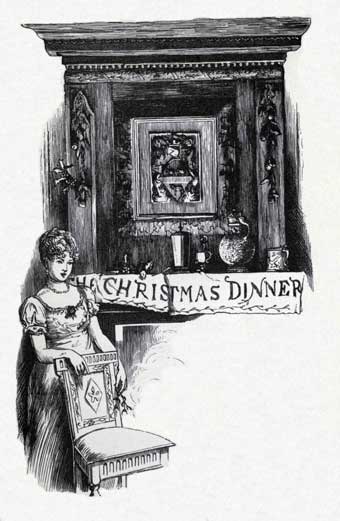
Just in this nick the cook knock'd thrice,The dinner was served up in the great hall, where the squire always held his Christmas banquet. A blazing, crackling fire of logs had been heaped on to warm the spacious apartment, and the flame went sparkling and wreathing up the wide-mouthed, chimney. The great picture of the crusader with his white horse had been profusely decorated with greens for the occasion, and holly and ivy had likewise been wreathed round the helmet and weapons on the opposite wall, and which I understood were the arms of the same warrior. I must own, by the by, I had strong doubts about the authority of the painting and armour as belonging to the crusader, they certainly having the stamp of more recent days; but I was told the painting had been so considered time out of mind; and that, as to the armour, it had been found in a lumber room, and elevated to its present situation by the squire, who at once determined it to be the armour of the family hero; and as he was absolute authority on all such subjects in his own household, the matter had passed into current acceptation. A sideboard was set out just under this chivalric trophy, on which was a display of plate that might have vied with Balshazzar's parade of the vessels of the temple: “flagons, cans, cups, beakers, goblets, basins, and ewers;” the gorgeous utensils of good companionship, that had gradually accumulated through many generations of jovial housekeepers; before these stood the two yule candles beaming like two stars of the first magnitude; other lights were distributed in branches, and the whole array glittered like a firmament of silver.
And all the waiters in a trice
His summons did obey;
Each serving man, with dish in hand,
March'd boldly up, like our train band,
Presented, and away.”5
We were ushered into this banqueting scene with the sound of minstrelsy; the old harper being seated on a stool beside the fireplace, and twanging the roast beef of old England, with a vast deal more power than melody. Never did Christmas board display a more goodly and gracious assemblage of countenances; those who were not handsome, were, at least, happy; and happiness is a rare improver of your hard-favoured visage. The parson said grace, which was not a short familiar one, such as is commonly addressed to the deity, in these unceremonious days; but a long, courtly, well-worded one, of the ancient school. There was now a pause, as if something was expected, when suddenly the Butler entered the hall, with some degree of bustle: he was attended by a servant on each side with a large wax light, and bore a silver dish, on which was an enormous pig's head, decorated with rosemary, with a lemon in its mouth, which was placed with great formality at the head of the table. The moment this pageant made its appearance, the harper struck up a flourish; at the conclusion of which the young Oxonian, on receiving a hint from the squire, gave, with an air of the most comic gravity, an old carol, the first verse of which was as follows:
Caput apri deferoThough prepared to witness many of these little eccentricities, from being apprized of the peculiar hobby of mine host; yet, I confess, the parade with which so odd a dish was introduced, somewhat perplexed me, until I gathered from the conversation of the squire and the parson, that it was meant to represent the bringing in of the boar's head, a dish formerly served up with much ceremony, and the sound of minstrelsy and song, at great tables on Christmas day. “I like the old custom,” said the squire, “not merely because it is stately and pleasing in itself, but because it was observed at the college at Oxford, at which I was educated. When I hear the old song chanted, it brings to mind the time when I was young and gamesome—and the noble old college hall —and my fellow students loitering about it in their black gowns, many of whom, poor lads, are now in their graves!''
Reddens laudes Domino.
The boar's head in hand bring I,
With garlands gay and rosemary
I pray you all synge merily
Qui estis in convivio.
The parson, however, whose mind was not haunted by such associations, and who was always more taken up with the text than the sentiment, objected to the Oxonian's version of the carol, which he affirmed was different from that sung at college. He went on with the dry perseverance of a commentator, to give the college reading, accompanied by sundry annotations, addressing himself at first to the company at large; but finding their attention gradually diverted to other talk, he lowered his tone as his number of auditors diminished, until he concluded his remarks in an under voice, to a fat-headed old gentleman next him, who was silently engaged in the discussion of a huge plate-full of turkey.
The table was literally loaded with good cheer, and presented an epitome of country abundance, in this season of overflowing larders. A distinguished post was allotted to “ancient sirloin,” as mine host termed it, being, as he added, “the standard of old English hospitality, and a joint of goodly presence, and full of expectation.” There were several dishes quaintly decorated, and which had evidently something traditionary in their embellishments, but about which, as I did not like to appear over curious, I asked no questions.
It would be tedious, perhaps, to my wiser readers, who may not have that foolish fondness for odd and obsolete things to which I am a little given, were I to mention the other make shifts of this worthy old humourist, by which he was endeavouring to follow up, though at humble distance, the quaint customs of antiquity. I was pleased, however, to see the respect shown to his whims by his children and relatives, who, indeed, entered readily into the full spirit of them, and seemed all well versed in their parts, having doubtless been present at many a rehearsal. I was amused, too, at the air of profound gravity with which the butler and other servants executed the duties assigned them, however eccentric. They had an old fashioned look, having, for the most part, been brought up in the household, and grown into keeping with the antiquated mansion, and the humours of its lord, and most probably looked upon all his whimsical regulations, as the established laws of honourable housekeeping.
Much of the conversation during dinner turned upon family topics, to which I was a stranger. There was, however, a great deal of rallying of master Simon about some gay widow, with whom he was accused of having a flirtation. This attack was commenced by the ladies; but it was continued throughout the dinner by the fat-headed old gentleman next the parson, with the persevering assiduity of a slow hound; being one of those long-winded jokers, who, though rather dull at starting game, are unrivalled for their talents at hunting it down. At every pause in the general conversation, he renewed his bantering in pretty much the same terms; winking hard at me with both eyes, whenever he gave master Simon what he considered a home thrust. The latter, indeed, seemed fond of being teased on the subject, as old bachelors are apt to be, and he took occasion to inform me, in an under tone, that the lady in question was a prodigiously fine woman, and drove her own curricle.
The dinner time passed away in this flow of innocent hilarity, and though the old hall may have resounded in its time with many a scene of broader rout and revel, yet I doubt whether it ever witnessed more honest and genuine enjoyment. How easy it is for one benevolent being to diffuse pleasure around him; and how truly is a kind heart a fountain of gladness, making every thing in its vicinity to freshen into smiles. The joyous disposition of the worthy squire was perfectly contagious; he was happy himself, and seemed disposed to make all the world happy; and the little eccentricities of his humour did but season, in a manner, the sweetness of his philanthropy.
When the ladies had retired, the conversation, as usual, became still more animated: many good things were broached which had been thought of during dinner, but which would not exactly do for a lady's ear; and though I cannot positively affirm that there was much wit uttered, yet I have certainly heard many contests of rare wit produce much less laughter. Wit, after all, is a mighty tart, pungent ingredient, and much too acid for some stomachs; but honest good humour is the oil and wine of a merry meeting, and there is no jovial companionship equal to that, where the jokes are rather small, and the laughter abundant.
The squire told several long stories of early college pranks and adventures, in some of which the parson had been a sharer; though in looking at the latter, it required some effort of imagination to figure such a little dark anatomy of a man, into the perpetrator of a mad-cap gambol. Indeed, the two college chums presented pictures of what men may be made by their dif?erent lots in life: the squire had quit the university to live lustily on his paternal domains, in the vigorous enjoyment of prosperity and sunshine, and had flourished on to a hearty and florid old age, whilst the poor parson, on the contrary, had dried and withered away, among dusty tomes, in the silence and shadows of his study. Still there seemed to be a spark of almost extinguished fire, feebly glimmering in the bottom of his soul; and as the squire hinted at a sly story of the parson and a pretty milk-maid whom they once met on the banks of the Isis, the old gentleman made an “alphabet of faces,” which, as far as I could decypher his physiognomy, I verily believe was indicative of laughter; and, indeed, I have rarely met with an old gentleman that took absolute offence at the imputed gallantries of his youth.
I found the tide of wine and wassail fast gaining on the dry land of sober judgment. The company grew merrier and merrier as their jokes grew duller. Master Simon was in as chirping a humour as a grasshopper filled with dew; his old songs grew of a warmer complexion, and he began to talk maudlin about the widow. He even gave a long song about the wooing of a widow, which he informed me he had gathered from an excellent black-letter work entitled “Cupid's Solicitor for Love;” containing store of good advice for Bachelors, and which he promised to lend me; the first verse was to this effect:
He that will woo a widow must not dally,This song inspired the fat-headed old gentleman, who made several attempts to tell rather a broad story out of Joe Miller, that was pat to the purpose; but he always stuck in the middle, every body recollecting the latter part except himself. The parson, too, began to show the effects of good cheer, having gradually settled down into a doze, and his wig setting most suspiciously on one side. Just at this juncture we were summoned to the drawing room, and I suspect, at the private instigation of mine host, whose joviality seemed always tempered with a proper love of decorum.
He must make hay while the sun doth shine;
He must not stand with her, shall I, shall I,
But boldly say, Widow thou must be mine.
After the dinner table was removed, the hall was given up to the younger members of the family, who, prompted to all kind of noisy mirth, by the Oxonian and master Simon, made its old walls ring with their merriment, as they played at romping games. I delight in witnessing the gambols of children, and particularly at this happy holiday season, and could not help stealing out of the drawing-room on hearing one of their peals of laughter. I found them at the game of blind-man's-buff. Master Simon, who was the leader of their revels, and seemed on all occasions to fulfil the office of that ancient potentate, the Lord of Misrule,6 was blinded in the midst of the hall. The little beings were as busy about him as the mock fairies about Falstaff, pinching him, plucking at the skirts of his coat, and tickling him with straws. One fine blue-eyed girl of about thirteen, with her flaxen hair all in beautiful confusion, her frolick face in a glow, her frock half torn off her shoulders, a complete picture of a romp, was the chief tormentor; and from the slyness with which master Simon avoided the smaller game, and hemmed this wild little nymph in corners, and obliged her to jump shrieking over chairs, I suspected the rogue of being not a whit more blinded than was convenient.
When I returned to the drawing room, I found the company seated round the fire, listening to the parson, who was deeply ensconced in a high-backed oaken chair, the work of some cunning artificer of yore, which had been brought from the library for his particular accommodation. From this venerable piece of furniture, with which his shadowy figure and dark weazen face so admirably accorded, he was dealing forth strange accounts of the popular superstitions, and legends of the surrounding country, with which he had become acquainted in the course of his antiquarian researches. I am half inclined to think that the old gentleman was himself somewhat tinctured with superstition, as men are very apt to become, who live a recluse and studious life in a sequestered part of the country, and pore over black-letter tracts, so often filled with the marvellous and supernatural. He gave us several anecdotes of the fancies of the neighbouring peasantry, concerning the effigy of the crusader, which lay on the tomb by the church altar. As it was the only monument of the kind in that part of the country, it had always been regarded with feelings of superstition by the good wives of the village. It was said to get up from the tomb and walk the rounds of the church yard of stormy nights, particularly when it thundered; and one old woman whose cottage bordered on the church yard had seen it, through the windows of the church, when the moon shone, slowly pacing up and down the aisles. It was the belief that some wrong had been left unredressed by the deceased, or some treasure hidden, which kept the spirit in a state of trouble and restlessness. Some talked of gold and jewels buried in the tomb, over which the spectre kept watch; and there was a story current of a sexton in old times who endeavoured to break his way to the coffin at night; but just as he reached it, received a violent blow from the marble hand of the effigy, which stretched him senseless on the pavement. These tales were often laughed at by some of the sturdier among the rustics, yet when night came on, there were many of the stoutest unbelievers that were shy of venturing alone in the footpath that led across the church yard.
Indeed, from other anecdotes that followed, the crusader appeared to be the favourite hero of ghost stories throughout the vicinity. His picture, which hung up in the hall, was thought by the servants to have something supernatural about it; for they remarked that, in whatever part of the hall you went, the eyes of the warrior were still fixed on you. The old porter’s wife too, at the lodge, who had been born and brought up in the family, and was a great gossip among the maid servants, affirmed, that in her young days she had often heard say, that on midsummer eve, when it is well known all kinds of ghosts, goblins, and fairies, become visible and walk abroad, the crusader used to mount his horse, come down from his picture, ride about the house, down the avenue, and so to the church to visit the tomb; on which occasion the church door most civilly swung open of itself: not that he needed it; for he rode through closed gates and even stone walls, and had been seen by one of the dairy maids to pass between two bars of the great park gate, making himself as thin as a sheet of paper.
All these superstitions I found had been very much countenanced by the squire, who, though not superstitious himself, was very fond of seeing others so. He listened to every goblin tale of the neighbouring gossips with infinite gravity, and held the porter's wife in high favour on account of her talent for the marvellous. He was himself a great reader of old legends and romances, and often lamented that he could not believe in them, for a superstitious person, he thought, must live in a kind of fairy land.
Whilst we were all attention to the parson’s stories, our ears were suddenly assailed by a burst of heterogeneous sounds from the hall, in which were mingled something like the clang of rude minstrelsy, with the uproar of many small voices and girlish laughter. The door suddenly flew open, and a whimsical train came trooping into the room, that might almost have been mistaken for the breaking up of the court of Fairy. That indefatigable spirit, master Simon, in the faithful discharge of his duties, as lord of misrule, had conceived the idea of a Christmas mummery, or masqueing; and having called in to his assistance the Oxonian and the young officer, who were equally ripe for anything that should occasion romping and merriment, they had carried it into instant effect. The old housekeeper had been consulted; the antique clothes presses and wardrobes rummaged, and made to yield up the reliques of finery that had not seen the light for several generations; the younger part of the company had been privately convened from parlour and hall, and the whole had been bedizzened out, into a burlesque imitation of an antique masque.
The irruption of this motley crew, with mock instruments of music, and peals of light hearted laughter, was the consummation of uproar and merriment.
The worthy squire contemplated these fantastic sports, and this resurrection of his old wardrobe, with the simple relish of childish delight. He stood chuckling and rubbing his hands, and scarcely hearing a word the parson said, notwithstanding that the latter was discoursing most authentically on the ancient and stately dance of the Paon, or peacock, from which he conceived the minuet to be derived.7 For my part, I was in a continual excitement from the varied scenes of whim and innocent gayety passing before me. It was inspiring to See wild-eyed frolick and warm-hearted hospitality breaking out from among the chills and glooms of winter, and old age throwing off its apathy, and catching once more the freshness of youthful enjoyment. There was a quaintness too, mingled with all this revelry that gave it a peculiar zest: it was suited to the time and place; and as the old manor house almost reeled with mirth and wassail, it seemed echoing back the joviality of long-departed years.
But enough of Christmas and its gambols: it is time for me to pause in this garrulity. Me-thinks I hear the question asked by my graver readers, “To what purpose is all this—how is the world to be made wiser by this talk?" Alas! is there not wisdom enough extant for the instruction of the world? And if not, are there not thousands of abler pens labouring for its improvement?—It is so much pleasanter to please than to instruct—to play the companion rather than the preceptor. What, after all, is the mite of wisdom that I could throw into the mass of knowledge; or how am I sure that my sagest deductions may be safe guides for the opinions of others? But in writing to amuse, if I fail, the only evil is my own disappointment. If, however, I can by any lucky chance, in these days of evil, rub out one wrinkle from the brow of care, or beguile the heavy heart of one moment of sorrow; if I can now and then penetrate through the gathering film of misanthropy, prompt a benevolent view of human nature, and make my reader more in good humour with his fellow beings and himself, surely, surely, I shall not then have written entirely in vain.
History of Music
Source: Research & Intro by Bryan Wright