
Search |



 November, 2020 November, 2020 | 12 Items | January, 2021  |
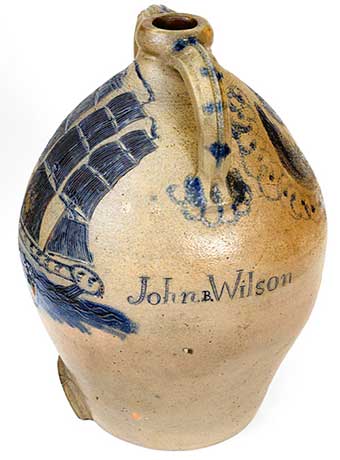
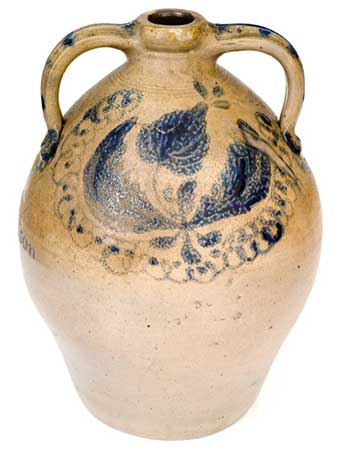
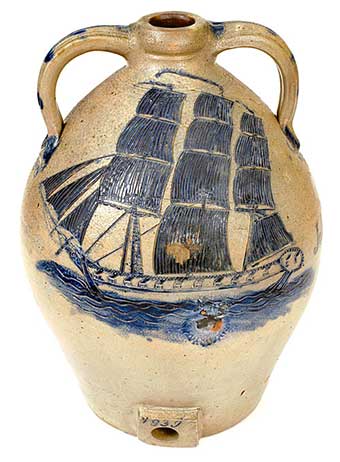
| | OUTSTANDING AND IMPORTANT FOUR-GALLON STONEWARE PRESENTATION COOLER, with Incised Ship Decoration, Inscribed "John B. Wilson" and Dated "1839," attributed to Abial Price, South Amboy, New Jersey, 1839, ovoid jug with semi-rounded spout, heavily-tooled shoulder, ribbed handles, and squared bunghole, decorated with a large incised and cobalt-highlighted sailing ship featuring three masts bearing large sails and three pennants, the bow with scrolled embellishment and bowsprit holding three smaller sails, the hull with eleven portholes, and stern with two portholes. Heavily incised waves, also highlighted in cobalt, appear below. Bunghole incised with cobalt-highlighted date, "1839." Side of cooler incised with the cobalt-highlighted name, "John B. Wilson." Reverse decorated with a distinctive brushed design of a tulip emanating from wreath-shaped leaves, characteristic of the work of the New Jersey-trained potter, Abial Price, underscored by a highly unusual band of overlapping circles, accented with spots. Striped decoration to handles and cobalt highlights to handle terminals. This work features one of the finest renderings of a sailing ship in American-made ceramics, noteworthy in its size and detail. The incised decoration, spanning an impressive 9.25" tall by 12" long, includes intricate and accurate features throughout, including exceptionally-deep carving to the vessel's sails and sawtoothed embellishments to the gunwale. This maritime masterwork is easily the finest example of New Jersey stoneware that we have ever offered and among the finest surviving works from a state integral in the development of the American salt-glazed stoneware tradition. Provenance: Ex-Leigh Keno, New York, NY. Condition: Surface cracks to shoulder on reverse, including a surface line extending to the spout and a surface line extending to the top surface of one handle. Some of the surface cracks extend onto the upper shoulder of the cooler's front, where they become fainter. Two in-the-firing contact marks to front. H 16.5”. Sold at Crocker Farm Fall 2020 Stoneware Auction held December 4, 2020. Estimate: $80,000-120,000 Price Realized: $210,000 |
| EXCEPTIONAL AND IMPORTANT SIX-GALLON STONEWARE CHURN, with Cobalt Pheasant-on-Flower Motif, Stamped "HARRINGTON & BURGER/ ROCHESTER," New York State origin, circa 1852-1854, ovoid jar with tooled shoulder, flared collar, and applied lug handles, decorated with a large slip-trailed design of a crested pheasant with turned head, striped body, and long tail, perched on an elaborate daisy plant with spotted blossom. Slip-trailed "6." to shoulder. Cobalt highlights to maker's mark. This work reveals Burger's ability at depicting flora and fauna in a highly-detailed, life-like manner, which surpassed that of all other American stoneware decorators. The pheasant motif is exceedingly rare in Burger's production with only a few pieces decorated with this design known. While the value of this work is obvious in its extravagant slip-trailed design and maker, the rarity of the motif increases the vessel's importance. While other known Burger pheasant motifs depict the bird perched on a branch, this example features it resting atop a flower, a folky inaccuracy in the sizing of the design elements also seen in the work of the Norton family of Bennington, Vermont. Burger produced this piece during the short-lived partnership he maintained with one of New York State's other leading potters, Thompson Harrington. The decoration is unquestionably in Burger's hand. Burger's drawings in cobalt slip are noteworthy in the time it took to produce each one and, as noted, in their high artistic quality, considering his work was made for utilitarian purposes and he had no academic training. Many in his day would be impressed to see a pencil drawing of the level of his work. The fact that he was able to create his images in unforgiving, flowing slip on a rounded vessel (that then need to be fired properly) is remarkable. The verticality and incredible size of the design, measuring 21" tall, nicely complements the piece's large and desirable churn form. Easily the most important example of Rochester stoneware to come to auction in recent years. Provenance: A fresh-to-the-market example, from a recently-surfaced Brooklyn, NY collection. Condition: Rim on reverse with a shallow 1.125" x 1.125" chip and a small chip. Areas of staining from use to surface. A tiny nick and minor flake to interior of rim. H 21”. Sold at Crocker Farm Fall 2020 Stoneware Auction held December 4, 2020. Estimate: $10,000-15,000 Price Realized: $40,000 | |
| OUTSTANDING AND RARE FIVE-GALLON STONEWARE JAR, with Cobalt Cornucopia Decoration, Stamped "JOHN BURGER / ROCHESTER," NY State origin, circa 1860, cylindrical crock with semi-rounded rim and applied lug handles, decorated with a large slip-trailed design of a scrolled cornucopia brimming with two large flowers, leaves, and a hanging flower bud. Heavy shading to cornucopia and leaf extending from its scrolled end. Slip-trailed "5." to shoulder. Cobalt highlights to maker's mark. Relatively few examples of this decoration by Burger are known. This work reveals his ability at depicting flora in a highly-detailed, life-like manner that surpassed all other American stoneware decorators. Burger's cornucopias were famously copied by one or more Rochester-trained potters that traveled westward, implementing this motif on pieces of Ohio stoneware. This crock is the first Burger example bearing this design that we have offered. Provenance: A fresh-to-the-market example, from a recently-surfaced Brooklyn, NY collection Condition: Excellent condition with a small chip to interior of rim. H 13”. Sold at Crocker Farm Fall 2020 Stoneware Auction held December 4, 2020. Estimate: $4,000-6,000 Price Realized: $22,000 | |
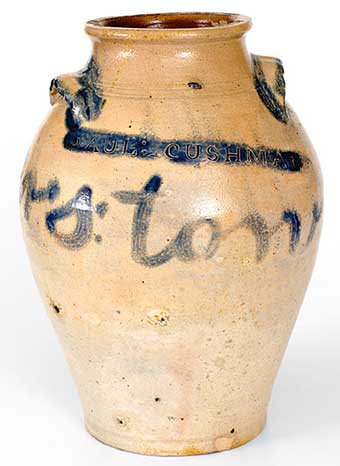
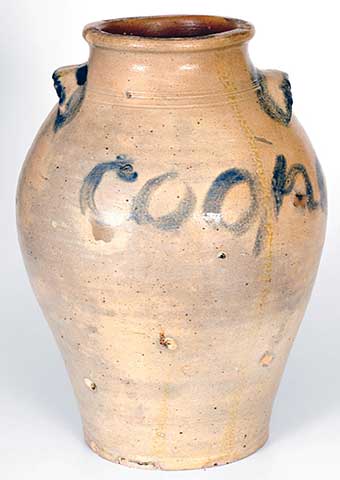
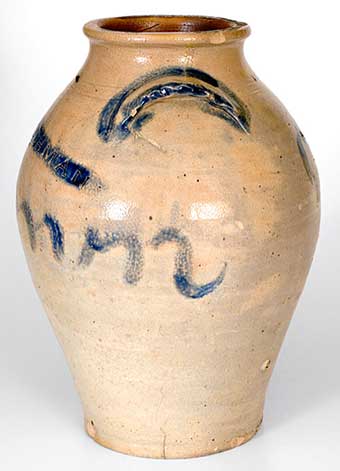
| | EXCEEDINGLY RARE AND IMPORTANT THREE-GALLON STONEWARE JAR, with Scalloped Handles and Cobalt Inscription, "Coopers:town," Stamped "PAUL : CUSHMANS," Albany, NY, circa 1812, vasiform jar with heavily-tooled shoulder, flared rim, and arching tab handles with scalloped carving to edges. Body of jar inscribed "Cooper:stown" in large cobalt script. Front of jar features the large maker's mark, "PAUL : CUSHMANS." Brushed cobalt highlights to maker's mark and handles. The village of Cooperstown in Otsego County, New York, was founded by William Cooper (1754-1809), a merchant, developer, and judge, who also served two terms in the United States Congress representing both Otsego County and Central New York. Cooper was also the father of James Fenimore Cooper (1789-1851), well-known author of several works of fiction, including The Last of the Mohicans. William Cooper originally established the town of Cooperstown in 1786 as the "Village of Otsego," as it was built of Otsego Lake. The village was incorporated in 1807, and the name was officially changed to Cooperstown in 1812 after its founder, who had died in Albany in 1809. It is believed that this jar was made to commemorate the renaming of the town and dates to the year 1812. Note the use of a colon between "Coopers" and "town" as seen on the coggled maker's mark, "PAUL : CUSHMANS." Of the town he founded, Cooper once wrote, "This was the first settlement I made, and the first attempted after the Revolution; it was, of course, attended with the greatest difficulties; nevertheless, to its success many others have owed their origin. It was besides the roughest land in all the state, and the most difficult of cultivation of all that had been settled; but for many years past it has produced everything necessary to the support and comfort of man." Today Cooperstown is best known as the home of the National Baseball Hall of Fame and also includes a number of other major museums. This work is the finest example of Paul Cushman stoneware to come to auction in years, featuring a highly-important inscribed decoration, brilliant color, and unusual ornamental handles. Provenance: Christies, Important American Furniture, Folk Art, Silver, and Prints, January 20-21, 2005, lot 288. Condition: A thin crack on underside, extending 6.5" up body of jar below one handle. Two base chips and a few minor base nicks. Two short, in-the-firing lines to base. A .625” chip to side of rim. A minor chip to each handle. Some in-the-firing pings and contact marks to surface, typical of pieces of this age and origin. H 15”. Sold at Crocker Farm Fall 2020 Stoneware Auction held December 4, 2020. Estimate: $10,000-15,000 Price Realized: $16,000 |
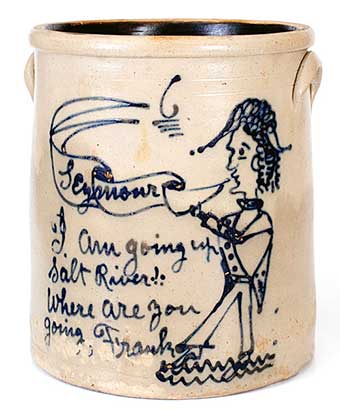
| OUTSTANDING AND IMPORTANT SIX-GALLON STONEWARE CROCK, with Cobalt Figural Decoration and Political Inscription, OH origin, 1868, large-sized, cylindrical crock with applied lug handles, tooled shoulder, and semi-rounded rim, featuring a large slip-trailed design of a standing man with hat and buttoned coat, holding a waving banner, inscribed "Seymour." Further inscribed below in cobalt slip, "I am going up / Salt River!. / Where are you / going Frank." Slip-trailed underscored "6" above. This political cartoon crock references the U.S. Presidential Election of 1868, in which Democratic candidate, New York Governor Horatio Seymour (1810-1886) was defeated by the Republican candidate, Ulysses S. Grant (1822-1885), Commanding General of the Union Army during the Civil War. Seymour, a popular figure in the Democratic Party, had served as the chairman of the Democratic National Convention in 1864 and 1868. After numerous indecisive ballots at the event in 1868, the convention nominated Seymour, a man who was not seeking the presidency, but reluctantly accepted. The choice before the voters between Grant and Seymour was also squarely one between civil rights and encroachment on the newly-found freedoms of blacks. Indeed, the Election of 1868 was the first presidential election after the abolition of slavery, and the entire fate of Southern blacks in particular was at stake, with even the Fifteenth Amendment (which enshrined universal suffrage) not being ratified until 1870. But beyond this, the plain racial dynamic of the election was made clear by Seymour's running mate, Union Major General Francis Blair (the "Frank" on the crock), who made racist invective part of his standard campaign rhetoric. (It's worth noting that one pro-Seymour political ribbon of the time was emblazoned with the motto, "This is a white man's country: let white men rule.") That the public understood the Seymour-Blair ticket to be one entwined with racism is seen, for example, in a couple of the newspaper items illustrated above that specifically reference the Ku Klux Klan. The public repudiated the Democrat ticket, with Grant winning in an electoral college landslide of 214 votes to Seymour's 80. He received strong support in his native state of Ohio, where this piece was made, winning by over 41,000 votes. His victory was in part achieved by 500,000 votes from blacks. The term "going up Salt River" is a slogan dating as early as 1827 that came to symbolize political defeat. It was popularized as a political term in 1839 by Ohio Representative, Alexander Duncan (1788-1853), when he used it in a House of Representatives speech. The Salt River is a 150 mile-long river that runs through Kentucky and empties into the Ohio River, the main waterway of the region. To "go up Salt River," then, is to take an unconventional and treacherous route that leaves you lost or worse. This crock, featuring historical significance, profuse decoration, and an exceptionally-larger 11" height to the rendering of Seymour, is regarded as a masterwork of Ohio stoneware and among the finest examples of regional stoneware to come to auction in years. Scattered exfoliation to base. Some fry to cobalt. Light staining. H 14". Sold at Crocker Farm Fall 2020 Stoneware Auction held December 4, 2020. Estimate: $15,000-25,000 Price Realized: $17,000 | |
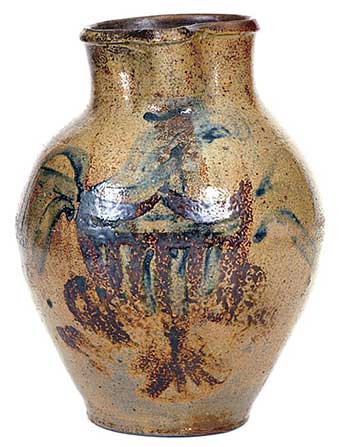
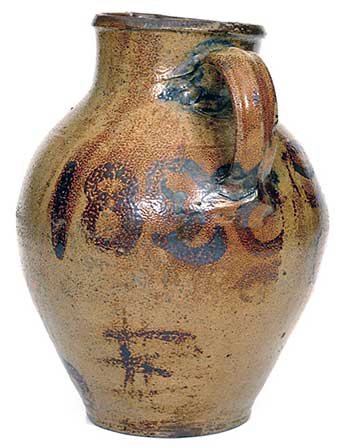
| | EXCEPTIONAL ONE-GALLON STONEWARE PITCHER, with Cobalt and Iron Federal Eagle Decoration, Dated "1820," Ohio River Valley origin, 1820, finely-potted pitcher with narrow base, highly-ovoid body, tooled shoulder, and short collar, decorated with a large design of a Federal eagle with shield across its chest, applied in widely-brushed strokes of cobalt and iron slip. Reverse of pitcher boldly-dated "1820" in large iron-slip numbers. A large looping flourish, also brushed in iron slip, appears to the right of the date on the reverse/side of the pitcher. Additional crosshatched and figure eight designs appear at the base of the pitcher. Brushed cobalt highlights the handle terminals. This pitcher was produced early in the introduction of cobalt-decorated stoneware to the rapidly-developing Ohio River Valley. Related works include an outstanding large-sized cooler with incised Federal eagle motif, also highlighted in blue and brown slips. Combining a large two-color-slip figural design, extremely early date, and stylish form, this pitcher is among the most important stoneware pieces from the region to come to auction in years. Few pieces of this age and origin exhibit decorative quality of this level, the heavy-handed brushwork and juxtaposition of colors creating a wonderful folk art representation of our national symbol. Condition: Restoration to an approximately 4" x 1.75" section of the rim, extending from reverse to side of pitcher. An additional minor restored chip to rim on reverse. Restored chips to interior of rim. A .75” filled and colored base chip. A tiny unrestored base chip. A small in-the-firing chip to edge of handle. H 11”. Sold at Crocker Farm Fall 2020 Stoneware Auction held December 4, 2020. Estimate: $5,000-7,000 Price Realized: $7,000 |
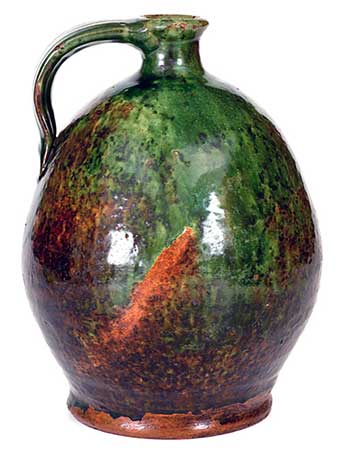
| EXCEPTIONAL COPPER AND MANGANESE GLAZED REDWARE JUG, Maine origin, early 19th century, highly-ovoid jug with footed base, flared spout, and applied strap handle, the surface decorated with a striking combination of manganese and copper glazes. The employment of both colors on the same jug is highly unusual, creating a beautiful work of folk expression--indeed, among the most beautifully-glazed New England redware objects we have handled. Condition: Surface wear. Two base chips. Chips to underside. H 11.25". Sold at Crocker Farm Fall 2020 Stoneware Auction held December 4, 2020. Estimate: $1,000-2,000 Price Realized: $10,000 | |
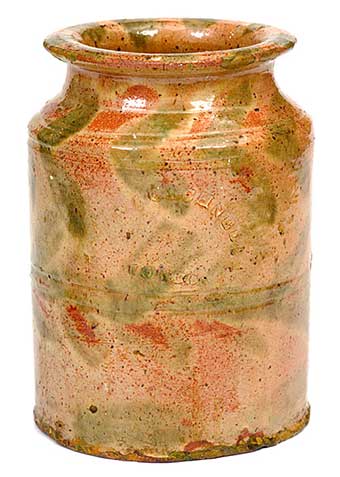
| VERY RARE AND IMPORTANT REDWARE JAR, with Green Foliate Decoration, Stamped "W. BURCHNELL / LONDON," William Burchnell, London, Madison County, Ohio origin, circa 1835, straight-sided jar with tooled midsection and shoulder, tapered neck, and flattened rim. Surface covered in a speckled, straw-colored slip applied over a speckled reddish ground, then decorated with a continuous band of brushed copper-slip vining around the midsection, paired leaves at the shoulder, and a wavy stripe at base. Top of rim decorated with copper-slip stripes. Interior and exterior surface covered in a clear lead glaze. The potter, William Burchnell, was trained in Morgantown, Virginia (now West Virginia), and had joined fellow Morgantown potter, James M. Thompson, Jr., in London, Ohio by 1830, establishing a pottery on the site of the town's Presbyterian Church. Only a few signed examples of Burchnell's work are known, this jar being the only such piece to feature brushed slip decoration and the only to employ copper-oxide in its design. This jar is a wonderful example of migration of style among 19th century American artisans. Its decoration can be directly linked to earlier vessels produced in Morgantown by Jacob Foulke and John Wood Thompson. Pieces bearing the jar's distinctive straw-colored ground have also been documented in the work of Morgantown's potteries. The high decorative appeal of this jar rank it among the better signed examples of Ohio redware known. Condition: Filled and colored rim chips. Heavy chipping to base, with some chips being filled and colored. Some in-the-firing flecks of exposed clay on surface have been touched up. H 6.75”. Sold at Crocker Farm Fall 2020 Stoneware Auction held December 4, 2020. Estimate: $7,000-9,000 Price Realized: $30,000 | |
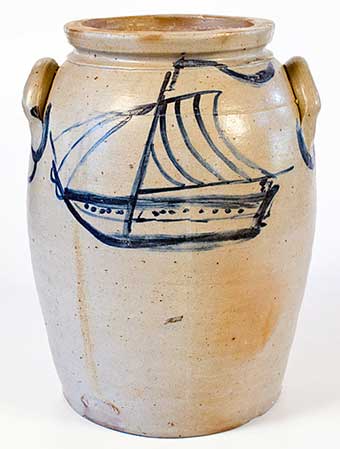
| | EXCEEDINGLY RARE AND IMPORTANT FOUR-GALLON STONEWARE JAR, with Cobalt Sailing Ship and Flag Motifs, Baltimore, MD origin, circa 1840, ovoid jar with tooled shoulder, squared rim, and applied lug handles, decorated with a large brushed design of a sailing ship with waving pennant. The hull is decorated with a series of spots representing gun ports or portholes. Reverse decorated with a spotted and striped flag or pennant emanating from a flowering garland extending from handle to handle. The decoration on the reverse likely depicts a closer view of the pennant flying from the ship on the front, probably representing a United States Navy commissioning pennant. Commissioning pennants were given to any ship commissioned by a given country's navy and flew the colors of the nation they represented. Once a commissioning pennant was hoisted, its entry into active naval service began. Typical U.S. Navy commissioning pennants featured a series of white-on-navy stars followed by a series of red-and-white stripes. The jar's reverse is additionally decorated with six vertically-brushed cobalt slash marks, reminiscent of the gallon markings on Edgefield, South Carolina stoneware, appear at the shoulder. In this case, the meaning of the markings is unknown, as the jar measures four gallons and is marked as such under one handle. Cobalt highlights to handle terminals with a curved line of cobalt extending from terminal to terminal under one handle. Excellent color, featuring dark, crisp cobalt against distinctive light-gray Baltimore clay. To date, only four other pieces of 19th century Southern stoneware featuring ship decorations have been documented. Two of this group also originate from Baltimore, one being an incised ship jar with related floral motif, attributed to Elisha Parr, and currently on display at the William C. and Susan S. Mariner Southern Ceramics Gallery at the Museum of Early Southern Decorative Arts in Winston-Salem, North Carolina. Among the most outstanding examples of regional stoneware to come to market in recent years. Provenance: A recently-surfaced work. Condition: Excellent condition with a shallow chip to one handle and a shallow in-the-firing chip to opposite handle (which is glazed over). H 15”. Sold at Crocker Farm Fall 2020 Stoneware Auction held December 4, 2020. Estimate: $8,000-12,000 Price Realized: $10,000 |
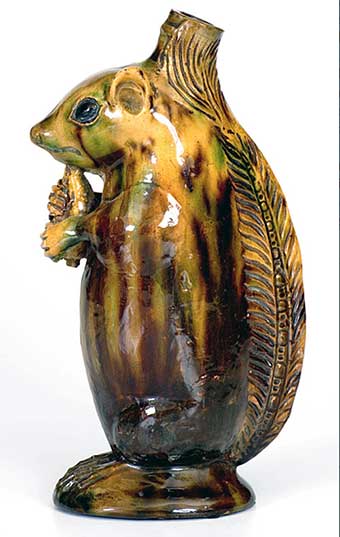
| EXCEPTIONAL GLAZED REDWARE SQUIRREL BOTTLE, Salem, NC origin, circa 1804-1829, molded figure of a standing squirrel holding a strawberry, the surface decorated with streaks of copper and manganese over a yellow ground and covered in a clear lead glaze. The mold of this bottle differs from two other types of squirrel bottles documented in Johanna Brown's Ceramics in America 2009 article, "Tradition and Adaptation in Moravian Press-Molded Earthenware." Other period bottles produced from a similar or identical mold can be seen in Erickson, Hunter, and Hannah, Ceramics in America 2009, "Making a Moravian Squirrel Bottle," figs. 23-25. The mold used on this particular bottle includes a less-commonly-seen, angled spout with beaded edge that extends off the back of the squirrel's head. Interestingly, the bottle to be auctioned features a different style of coggled decoration on the squirrel's tail than is commonly seen, featuring an open circle followed by smaller punctates. Typical coggling on the squirrel's tail appears as a continuous series of open circles or punctates. In addition, while most Moravian squirrels depict a small clay ball (or nothing at all) between the squirrel's paws, this example features a well-defined strawberry with raised seeds and small stem. This work is also the first Salem squirrel bottle that we have seen featuring dark slip highlighting the eyes. This treatment, however, can been seen on lady bottles and at least one owl from this school. The owl, likely made during the same period as this squirrel, features closely-related streaked copper and manganese decoration over a yellow clay ground. Despite condition issues, this previously-undocumented piece is a noteworthy new discovery in Moravian molded ware, ranking among the most high-styled squirrel bottles produced in this Southern ceramics tradition. Provenance: Recently surfaced in Ohio. Condition: Significant restoration to exfoliation throughout the lower two-thirds of the bottle. The head, spout, and ears remain unrestored. The squirrel's hands and strawberry are largely unrestored, except for a small area of restoration to one finger and some possible small coloring or restoration to one side of the strawberry. Most or all of the base and feet are unrestored, except for some possible restoration to the area between the squirrel's feet. Minor wear to edge of one ear. Minor exfoliation to tail. H 8.5”. Sold at Crocker Farm Fall 2020 Stoneware Auction held December 4, 2020. Estimate: $1,000-1,500 Price Realized: $2,000 | |
| EXCEPTIONAL ONE-GALLON STONEWARE JAR, with Elaborate Bird-and-Floral Decoration, Stamped "HARRISBURG PA.," John Young, Harrisburg, PA, circa 1856-1858, cylindrical form with tooled shoulder, flared collar, and applied lug handles, decorated with a slip-trailed design of a bird perched on the stem of a flowering daisy plant. Slip-trailed spotted and circular details to blossom and cobalt accents to the edges and interiors of leaves. Bird features a highly-unusual brushed-cobalt body with undecorated areas delineating the wing and eye. The tail is depicted in a style distinctive to Young, resembling a leaf. Cobalt highlights to maker's mark and handle terminals. Excellent use of both slip-trailed and brushed elements to the design, a characteristic of Young's work, indicative of his New York training, but rarely seen in the output of other Harrisburg potters. The composition of this jar's design is unusual in its depiction of both a bird and flowering plant on the same piece. Any figural decorations by Young are considered rare, with this example boldly presenting its bird in solid cobalt, an uncommon depiction in the Harrisburg stoneware tradition. Coupled with the rarity of this jar's decoration and maker is a desirable one-gallon capacity to the vessel, a size that is typically difficult to find with figural decoration. Condition: A thin 5" crack on underside, extending 3.125" up side of jar. A 1.5" line above one handle, mostly in-the-surface only, a small portion of which is visible on the interior. A minor .625” surface line to rim on front, not visible on interior. A minor chip to right handle. A minor rim chip on reverse. Wear to inner rim for lid. In-the-firing mottling to surface. Provenance: Ex-Chris Machmer. H 10”. Sold at Crocker Farm Fall 2020 Stoneware Auction held December 4, 2020. Estimate: $3,000-5,000 Price Realized: $8,500 | |
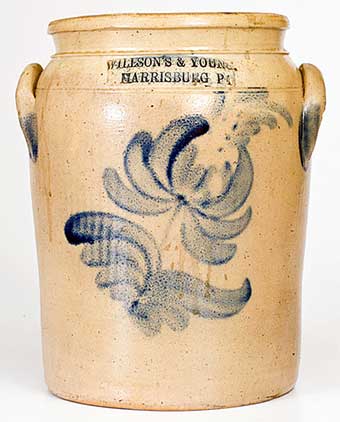
| VERY RARE ONE-GALLON STONEWARE JAR, with Cobalt Tulip Decoration, Stamped "WILLSON'S & YOUNG. / HARRISBURG PA," circa 1855, cylindrical jar with tooled shoulder, semi-rounded rim molding, and applied lug handles, decorated with a large brushed design of a tulip with pronounced stamen. Cobalt highlights to maker's mark and handle terminals. Desirable size and fine color. Provenance: Purchased by the consignor at Roan Auction's Sale of the Eleanor C. Stipp Collection in the 1980s. Stipp reportedly had family connections to the Harrisburg stoneware industry. Red labels on the jar's reverse and underside indicate the piece's maker and Stipp provenance. Condition: Excellent condition with a small in-the-firing chip to underside at edge and a chip to each handle. Sold at Crocker Farm Fall 2020 Stoneware Auction held December 4, 2020. Estimate: $1,000-2,000 Price Realized: $4,250 |




 |  |  |
Colonial Sense is an advocate for global consumer privacy rights, protection and security.
All material on this website © copyright 2009-25 by Colonial Sense, except where otherwise indicated.
ref:T3-S24-P9120-C-M
All material on this website © copyright 2009-25 by Colonial Sense, except where otherwise indicated.
ref:T3-S24-P9120-C-M